


Case study · Design & funnel build
LiveOCLA Sales Funnel
A hand-built sales page and the automated opt-in funnel behind it — designed end to end.
- HTML/CSS/JS
- Klaviyo
- Meta Pixel
- Skool
- Vercel
- 2
- Pages, hand-built
- 0
- Frameworks
- 7
- Nurture emails
- 3
- Funnel tools
This is the public face of OCLA — the sales page that sells the program and the automated funnel that turns a curious visitor into a free-trial member. I designed and built all of it by hand: a long-form, video-led sales page with a clear story and a five-part breakdown of how the program works; a separate lead-magnet opt-in page; and the email sequence that follows up automatically once someone opts in. It's the counterpart to the OCLA app case study — that one is the software; this is the design and the go-to-market funnel that live in front of it.
Inside the funnel

The design — the part worth looking at
The sales page is built to do one job well: take a coach who's tried and struggled to get online and walk them all the way to “okay, I'll try this.” So it's a designed argument, not a brochure. It opens on the problem, contrasts the way most coaches go online with the way OCLA builds it instead, earns trust with a six-year founder story, then lays the program out as five named systems before a four-phase visual roadmap, an exactly-what's-included section, an FAQ, and a clear “who this is (and isn't) for.”
The five systems the page is built around
- The Online Foundation Blueprint
- The Warm Audience Activation System
- The Dual-Channel Growth Engine
- The Sustainable Freedom Model
- The Always-On Accountability System
It runs on a real visual system, on brand (The Fitness Stall): custom roadmap illustrations for each phase, founder photography, in-product screenshots, short looping videos and a VSL — composed into one consistent look, not a stock template. Motion is used with restraint: video where it earns attention, static and legible everywhere else.
Under the hood
How it's actually built and wired. The plain version is above — everything from here down is the technical detail.
The funnel — wired end to end
The page is the front of a complete, automated funnel — and the interesting part is that there's no funnel-builder platform under it. I assembled it from primitives:
- 1
Lead magnet → opt-in
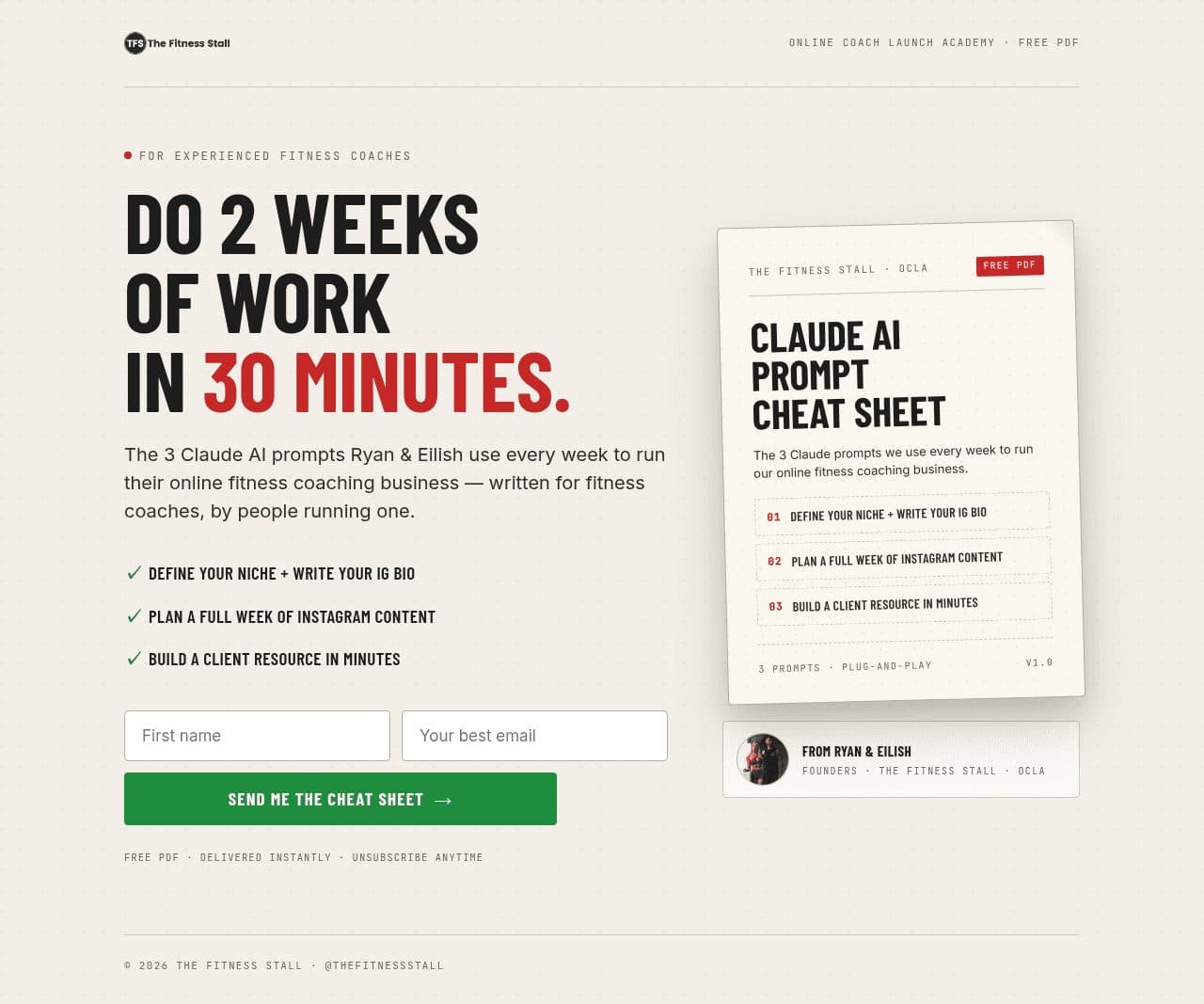
A separate opt-in page (
/claude-cheat-sheet) offers a free resource. The form posts directly to the Klaviyo API — no plugin, no middleman — and fires a Meta PixelSubscribeevent the moment it succeeds. - 2
Automated nurture
Joining the list triggers a live 7-email Klaviyo flow (“Added to List”), spaced across the seven-day free-trial window — the first email immediate, the rest on daily delays — with profile-property steps at entry and exit so the sequence stays clean.
- 3
The handoff
Every “Start 7-Day Free Trial” call to action routes to the Skool community, where trial-to-paid and the member experience live. The sales page persuades; Skool converts and hosts.
- 4
Measurement
Meta Pixel on both pages (
PageVieweverywhere,Subscribeon opt-in) so the ad spend feeding the top of the funnel is actually attributable.
The point: I can take a marketing idea and stand up the whole path — page, capture, follow-up, tracking, handoff — not just one piece of it.
Build the funnel from primitives, not a funnel platform
Page-builder platforms are quick, but they own your pages, your data, and a monthly fee. Static pages on Vercel plus Klaviyo and Pixel wired in directly means OCLA owns the asset outright — and it loads instantly.
ClickFunnels / Kajabi-style tools rent you a funnel. Building the page as static HTML on Vercel and talking to Klaviyo + Pixel directly means OCLA owns the asset outright, it loads instantly, and there's nothing to rent. It's the same ownership argument I make to clients — applied to my own funnel.
Let each tool do the one thing it's best at
The sales page persuades, Klaviyo nurtures, Skool handles trial-to-paid and community. Rather than force one platform to do all three badly, I designed the clean seams between them.
Instead of one all-in-one platform doing three jobs poorly, each layer does what it's best at — and the work is in the seams: the opt-in handoff to Klaviyo, the pixel events, the trial CTA into Skool. Those joins are what make the funnel measurable and reliable.
Where it is now
It's live at onlinecoachlaunchacademy.com, running the full funnel — opt-in capture, the automated seven-email sequence, and the Skool trial handoff. OCLA itself is now in maintenance mode, but the funnel stands as a complete, working example of the design and go-to-market side of a launch — the part that lives in front of the software.
Want to see how it's wired?
See the page live, or I'll happily walk through the design choices and how the funnel is put together.